
Top 5 Crypto Payment Services for Global Businesses in 2026
International payments are still expensive and slow when they go through traditional banks. Merchants often lose around 2–4% per transaction to intermediaries and can wait several days before funds arrive.
Crypto payment gateways try to solve this by offering faster settlement and lower fees, while also giving access to a global base of more than 700 million crypto users. In practice, though, results vary a lot between providers.
Some platforms build in conversion spreads that are not obvious at first. Others operate with limited regulatory coverage, or leave merchants dealing with price volatility on their own. Choosing the wrong solution can lead to compliance issues, integration problems, or unstable cash flow. Here’s how the top five options compare at a glance:
| Firm | Best for | Founded | Processing fee | Notable specialty |
|---|---|---|---|---|
| NOWPayments | Multi-coin acceptance | 2019 | 0.5% | 350+ cryptocurrencies |
| Swapin | Fiat-settled merchants | 2017 | 0.8-1.35% + network | EU-licensed conversion |
| CoinRemitter | Cost-conscious merchants | — | 0.23% | No KYC required |
| Paybis | Consumer crypto purchases | 2014 | — | 48 U.S. states coverage |
| BVNK | Enterprise stablecoin ops | — | Custom pricing | Multi-rail infrastructure |
Paybis
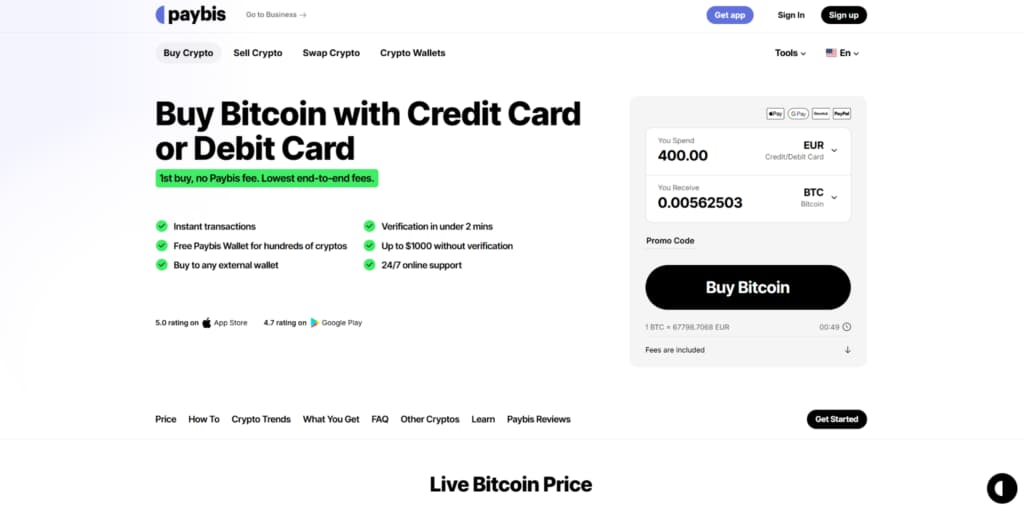
Founded in 2014, Paybis operates as a consumer-facing crypto exchange rather than a pure merchant gateway, but its 48 U.S. states and 180+ countries coverage makes it relevant for businesses selling crypto-related products or services. The platform’s near-perfect score on Trustpilot reflects a customer-service focus unusual in the crypto space.
A platform for buying cryptocurrency with credit or debit cards, available across 48 U.S. states and more than 180 countries. The service offers 24/7 customer support and is widely used for retail crypto purchases.
Supported assets:
- Buy Bitcoin with a credit card
- Buy Ethereum
- Buy Litecoin
- Sell cryptocurrency
The platform includes a crypto wallet, staking rewards, and currency exchange functionality. Verified accounts can purchase up to $20,000 per day or $50,000 per month, with transactions completing in 2-10 minutes depending on verification status.
Pros:
- Extensive geographic coverage (48 U.S. states)
- Consumer-grade UX with 24/7 support
- Multi-year operational track record since 2014
Cons:
- Consumer exchange model vs. merchant payment gateway
- Higher fees typical of retail crypto platforms
Weakness: No transparent merchant processing fee structure documented—businesses would need custom quotes for payment acceptance vs. consumer purchase flows.
NOWPayments
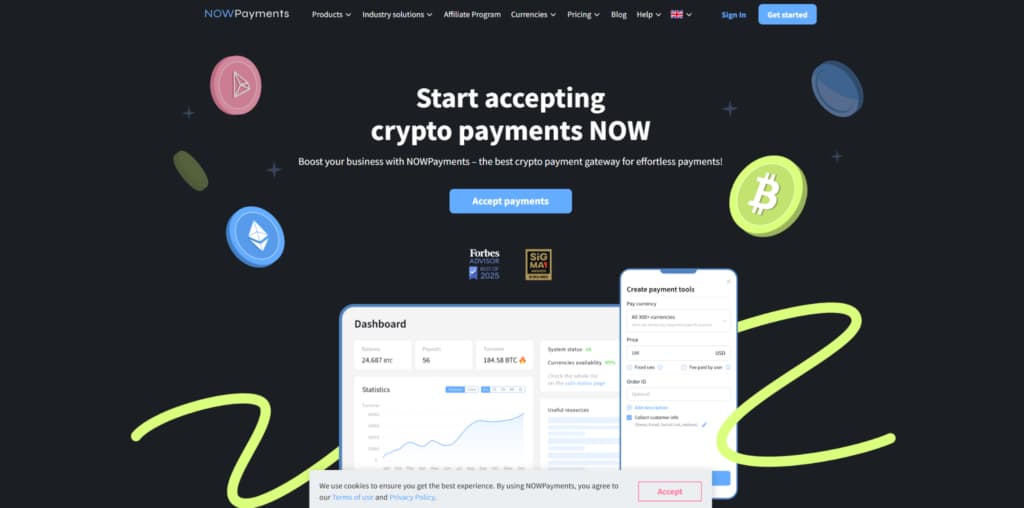
NOWPayments is a non-custodial crypto payment gateway that allows businesses to accept Bitcoin, Ethereum, and 350+ cryptocurrencies on their websites, online stores, and social media accounts with the lowest fees on the market.
NOWPayments started in 2019 and is mostly known for supporting a large number of cryptocurrencies. Fees are relatively low at around 0.5%, and the platform doesn’t hold user funds, so merchants stay in control during transactions.
In practice, the main selling point here is coverage. It works with hundreds of coins, including the usual ones like Bitcoin and Ethereum, plus a range of stablecoins. Transaction speed depends on the network, but in most cases it takes a few minutes. Support is available 24/7, although response quality can vary.
Setup is fairly simple, but not always “one click” in real use. There are plugins for WooCommerce, Magento, and other platforms, and API integration if you need more control. The system also supports invoice payments and basic point-of-sale features, though these are not as advanced as in some enterprise-focused tools.
Key features:
- 0.5% service fee with no withdrawal charges
- Non-custodial payments with enterprise-grade security
- Billing and sub-accounts for multi-location operations
- One-minute HTML code integration
Weakness: No publicly documented executive team or company structure, which may concern enterprise buyers conducting vendor due diligence.
Swapin
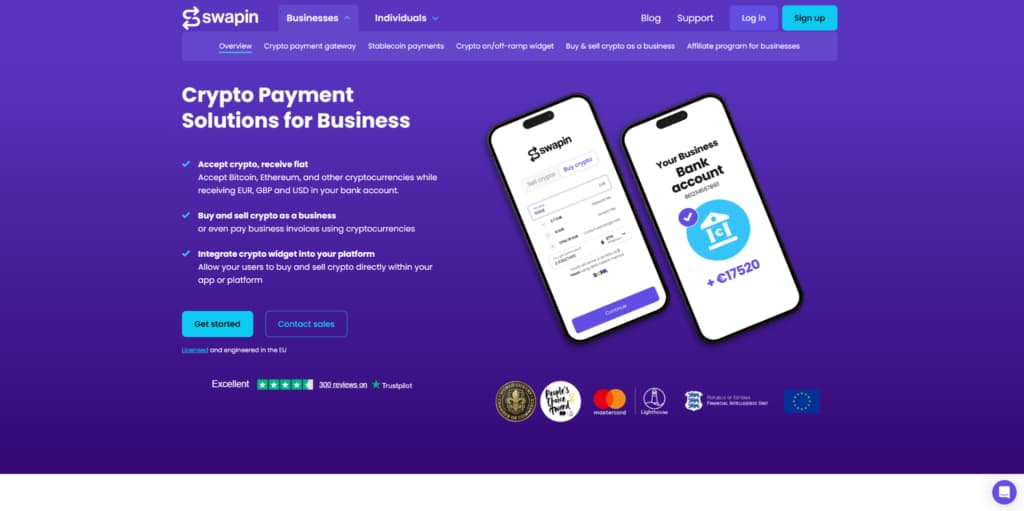
Swapin is an EU-licensed crypto payment solutions provider that connects crypto and banks, allowing businesses to accept crypto payments and receive fiat currency instantly in their bank account.
Operating since 2017, Swapin solves the volatility problem that keeps many merchants from accepting crypto: customers pay in cryptocurrency, but businesses receive euros, pounds, or dollars directly in their bank accounts with no exposure to price fluctuations. The platform’s EU licensing and Grant Thornton audit provide regulatory credibility that pure-crypto gateways lack.
| Transaction tier | Processing fee |
|---|---|
| €5 – €15,000 | 1.35% + network fee (min. €2.95) |
| €15,000 – €30,000 | 1.1% + network fee (min. €2.95) |
| €30,000+ | 0.8% + network fee (min. €2.95) |
The platform processes 95% of crypto-to-fiat transactions in 5 mins or less, with buy crypto from bank account functionality enabling bidirectional flows. Swapin supports API integration, payment links, and stablecoin payments for merchants prioritizing price stability.
Pros:
- Instant fiat settlement eliminates crypto volatility risk
- EU-licensed and Grant Thornton audited
- Volume-based fee discounts for high-throughput merchants
Cons:
- Higher fees than crypto-native gateways at lower volumes
- Geographic focus on European banking rails
Weakness: Limited documentation of supported cryptocurrencies beyond stablecoins—merchants needing altcoin acceptance may require clarification during onboarding.
CoinRemitter
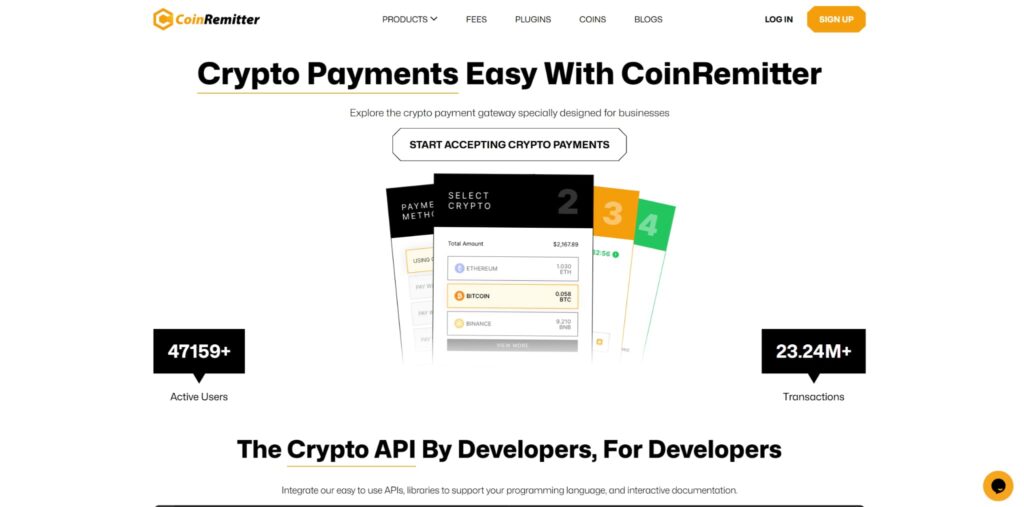
CoinRemitter targets cost-conscious merchants with its lowest crypto processing fees at 0.23%—less than half the rate of most competitors. The platform’s no KYC requirements streamline onboarding: merchants need only an email address to start accepting payments, with phone number verification optional.
CoinRemitter is a crypto payment processor that lets merchants accept payments with low fees of around 0.23% and no KYC requirement.
The gateway provides crypto payment API, open-source plugins, and digital wallet functionality. Webhook notifications deliver instant payment confirmations, while gas station fee reduction optimizes network costs for Ethereum-based transactions.
- Processing fee: 0.23% (lowest documented rate in this comparison)
- Integration: Open-source plugins for major e-commerce platforms
- Settlement: Internal wallet with zero fees; processing + network fees apply on withdrawal
- Compliance: No ID or KYC submission required
Weakness: No documented founding year or operational history, and no publicly listed executive team—factors that may concern merchants requiring vendor stability verification for payment infrastructure.
BVNK
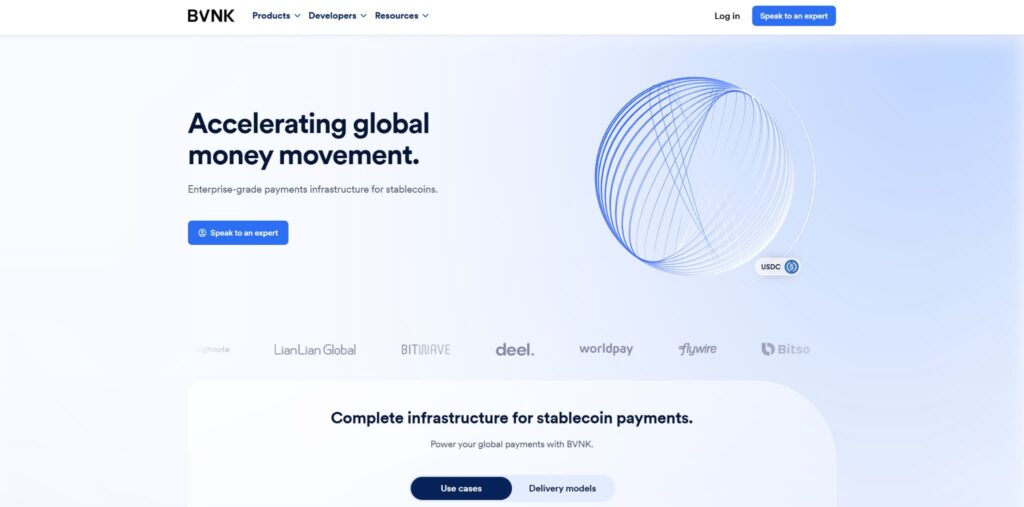
Accelerating global money movement. Enterprise-grade payments infrastructure for stablecoins that enables businesses to move value near-instantly across borders and networks.
BVNK targets enterprise clients with multi-rail, multi-asset, globally licensed infrastructure spanning traditional banking and blockchain networks. The platform operates under licenses in the US, EU, UK, and Singapore, providing regulatory coverage for multinational operations.
BVNK’s virtual accounts in USD, EUR, and GBP bridge fiat and crypto rails, while embedded wallets enable white-label integration into existing products.
| Feature | Capability |
|---|---|
| Payment rails | Send stablecoin payments globally |
| Conversion | Convert between currencies and on/off-ramp |
| Storage | Store funds in stablecoin-linked wallets |
| Orchestration | Payment orchestration across networks |
The platform requires at least $500,000 in monthly volume and six months of operating history, so it’s clearly aimed at enterprise clients. It also holds ISO 27001 and SOC 2 Type II certifications.
Weakness: No documented founding year and custom pricing only—small-to-midsize merchants will find the $500K monthly minimum prohibitive, and the lack of a transparent fee structure requires sales engagement for cost evaluation.
Final Thoughts
Not every crypto payment service works the same way, and the differences start to matter pretty quickly once you try to use them in real operations. Some are built around low fees and wide asset support. Others focus more on compliance, fiat settlement, or enterprise use cases. What actually fits depends on how your business handles payments day to day.
In practice, the choice usually comes down to trade-offs. Lower fees can mean less reliable support or weaker infrastructure. Faster settlement might come with stricter compliance requirements. It makes more sense to look at how the system fits into your workflow than to chase the cheapest option on paper.