
5 Trusted Legal Consultants for Crypto Licensing in Canada
Canada runs one of the oldest crypto licensing systems in the world. FINTRAC started regulating virtual currency service providers in 2014. The rules have been stable for over a decade. Banks recognize MSB registration. Foreign companies can operate without a physical office.
But stable does not mean simple. FINTRAC requires a full AML program before they review applications. The Travel Rule applies to crypto transfers over 1,000 CAD. CSA oversight kicks in when tokens look like securities. Banks still ask questions.
The firms that handle this work well have done it dozens of times. They know which compliance officers FINTRAC trusts. They know which banks open accounts. They know what documentation gets approved on the first submission.
Here are five trusted legal consultants for crypto licensing in Canada for 2026.
How They Stack Up
Here is how these crypto license service provider firms compare on the features that matter.
| Firm | Canada Office | Verified Client Win | Key Differentiator |
| Gofaizen & Sherle | Yes | Trustpilot reviews, Basal Pay case study | Physical Canada office, three service packages |
| Fast Offshore Licenses | No | Published Canada pricing | Transparent 9,800 USD starting cost |
| Samson Solutions | No | ChaosOTC testimonial | Client-verified Canada MSB success |
| Manimama | No | Listed in fastest registration category | Canada among top recommended jurisdictions |
| Stalirov & Co | No | Intellabridge regulatory work | FINTRAC + CSA dual expertise |
Those are the basics. Here is what each firm delivers.
1. Gofaizen & Sherle
Gofaizen & Sherle maintains a physical presence in Canada. That means when FINTRAC schedules an in-person meeting, someone walks into the building the same day. No travel delays. No time zone excuses.
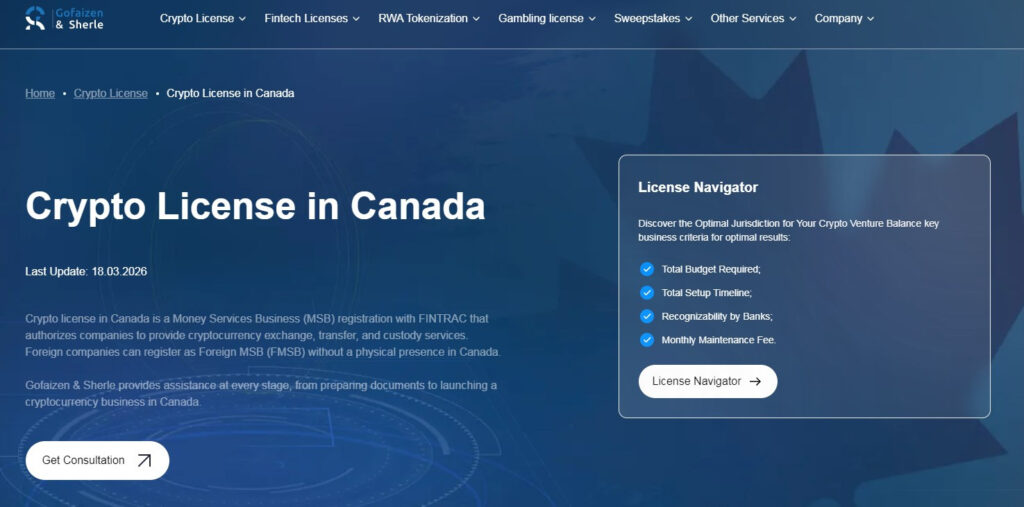
The firm has handled hundreds of licensing projects across more than 50 jurisdictions. Their Canada operation connects to offices in Europe, Asia, and Latin America. A client who wants MSB registration today and expansion into the EU next year works with the same team throughout.
Why they made the list:
- Their offerings for crypto licensing in Canada are designed for different client situations. The 9,800 USD option works for existing companies that only need the MSB registration. The 13,000 USD package adds company formation and a local director. The 15,200 USD tier includes corporate account setup with banks that accept crypto clients.
- The Crypto License Navigator runs jurisdiction comparisons based on four criteria: total budget, expected timeline, whether banks in that country open accounts for crypto firms, and monthly maintenance costs. Gofaizen & Sherle experts recommend running your business model through the tool before filing any application.
- Trustpilot reviews mention specific outcomes. One client said the firm delivered “clear guidance on regulatory compliance and contract negotiations” with “responsiveness, attention to detail, and ability to navigate intricate legal challenges.” Another client noted the team set up a dedicated follow-up group after the license arrived and handled post-license queries with “incredible speed.”
- Their crypto lawyers manage both FINTRAC and CSA applications separately. Some platforms need only MSB registration. Others need securities approval for token offerings. The firm runs both tracks in parallel when clients require both.
Ideal for: Crypto exchanges and tokenization platforms that want MSB registration with the ability to add other jurisdictions later, plus the reliability of a firm with boots on the ground in Canada.
2. Fast Offshore Licenses
Fast Offshore Licenses puts their Canada pricing right on the website. No calls needed to get a number. The MSB package starts at 9,800 USD. El Salvador shows 12,400 USD. Panama shows 2,850 USD. Everything sits there in plain view.
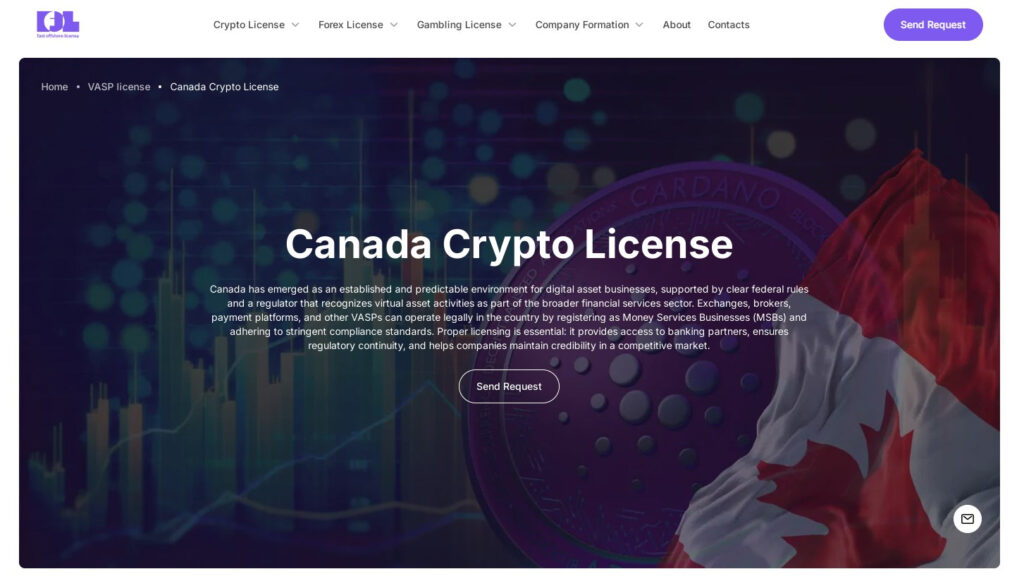
The firm built their reputation on offshore jurisdictions. Canada entered their portfolio because clients kept requesting it. Their team now handles MSB registration alongside their traditional offshore work.
Why they made the list:
- Their Canada package wraps everything into one price. Company formation. AML/KYC policy drafting. Regulator communication. No hourly billing. No line items that surprise clients later.
- They know the MSB versus FMSB distinction cold. Foreign companies serving Canadian customers remotely qualify for FMSB status. Fast Offshore matches clients to the correct registration type from day one.
- Banking access gets built into their service. They track which Canadian banks have accepted MSB-licensed crypto clients recently. That list changes. Their information stays current.
- Their post-license support includes automatic audit scheduling. FINTRAC requires annual independent audits. Fast Offshore sets them up without clients having to remember the deadline.
Ideal for: Startups and smaller operations that want upfront pricing and a clear timeline for Canada MSB registration without hourly billing surprises.
3. Samson Solutions
Samson Solutions built their practice around European licensing. But their work extends to Canada. A client named Denys from ChaosOTC s.r.o. publicly thanked them for MSB registration help.
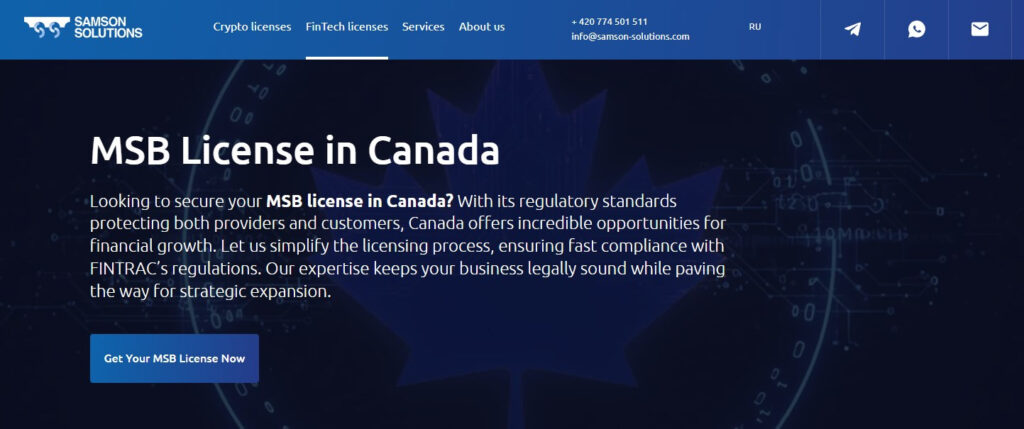
The testimonial appears on their website. It reads: “Special thanks to their team for helping us with MSB registration in Canada — everything went smoothly because of their expertise.” That is a verifiable client with a real company.
Why they made the list:
- Their MiCA experience transfers to Canada. The AML principles in Europe and Canada overlap significantly. Clients coming from EU markets do not need to re-explain their business model to a new firm.
- They offer legal consulting services for crypto business setup that include compliance officer appointment. FINTRAC requires a compliance officer responsible for AML procedures. Samson Solutions helps clients fill that role.
- Their Travel Rule implementation covers the technical side. FINTRAC requires sender and recipient data collection for transfers above 1,000 CAD. Samson Solutions builds that into the compliance framework before submission.
- They track reporting deadlines for clients. Suspicious transaction reports have specific timeframes. Samson Solutions keeps a calendar so nothing gets missed.
Ideal for: European crypto firms already operating under MiCA who want to add Canada MSB registration without switching to a new provider.
4. Manimama
Manimama works only with crypto companies. No gambling licenses. No forex licenses. Just crypto. Their website lists Canada in their licensing jurisdictions and puts Canada in the “fastest registration” category.
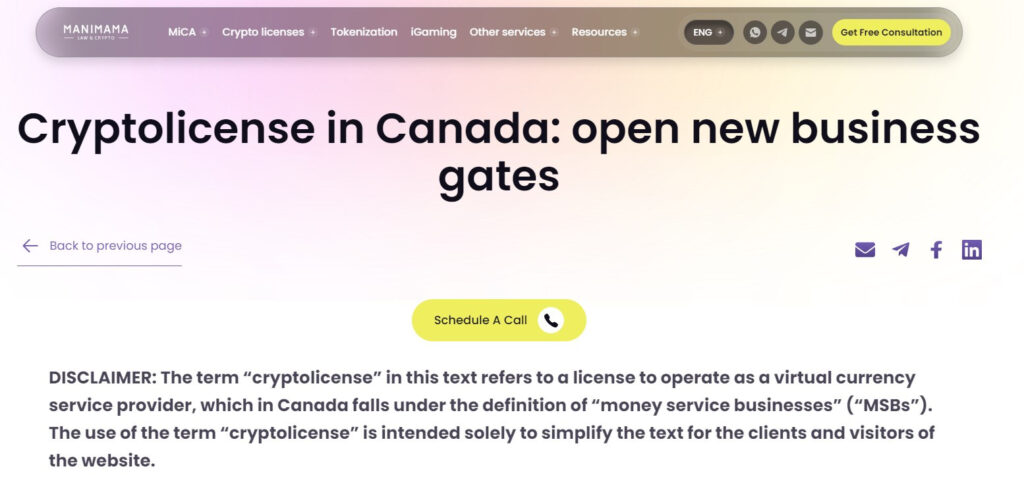
The firm operates out of Europe but has completed Canada MSB work multiple times. Their jurisdiction breakdown shows Canada alongside Lithuania, Poland, Cyprus, Malta, UAE, and Switzerland.
Why they made the list:
- They highlight Canada under “no requirement for initial capital.” FINTRAC does not mandate minimum share capital for MSB registration. That matters for startups watching their budget.
- Their team handles both MSB registration and the securities side when tokens qualify as investment contracts. CSA oversight applies in those cases. Manimama’s specialized crypto licensing firm status means they understand both tracks.
- They offer all-inclusive packages. Legal, compliance, and business development come from one point of contact. No juggling multiple vendors.
- Their post-license service includes compliance reviews scheduled six months after approval. FINTRAC often circles back with follow-up questions. Manimama makes sure clients have answers ready.
Ideal for: European crypto projects targeting Canadian market entry with a firm that specializes exclusively in crypto and offers bundled services.
5. Stalirov & Co
Stalirov & Co splits their practice between the US and Canadian markets. Their website explicitly mentions FINTRAC, CSA, and IIROC regulations. They have done Canada-specific regulatory work for clients.
The firm provided legal support for Intellabridge, a Colorado-based fintech company operating on the Canadian Securities Exchange. Their team prepared legal opinions covering FINTRAC, CSA, and IIROC requirements.
Why they made the list:
- They provide legal crypto consulting that covers both US MSB registration with FinCEN and Canada MSB registration with FINTRAC. Clients operating on both sides of the border work with one team instead of two.
- Their lawyers for obtaining crypto license prepare the compliance officer designation packages with specific attention to reporting lines. FINTRAC asks who the compliance officer reports to and whether that person has budget authority. Stalirov & Co documents those relationships clearly.
- Their ongoing compliance service includes a regulatory alert system for both countries. When FINTRAC updates guidance or CSA issues new notices, clients get summaries with action items. No digging through regulator websites.
- The firm operates from Princeton, New Jersey, giving them direct access to US regulators while maintaining Canada capability.
Ideal for: US-based crypto projects or international firms targeting North America who need MSB registration in both the United States and Canada.
FAQ
Here are questions that come up during Canada MSB applications.
What is the difference between MSB and FMSB?
MSB applies when your company has a physical presence in Canada. FMSB applies when your company operates from outside Canada but serves Canadian customers. Both register with FINTRAC. Both need the same AML compliance program.
Does FINTRAC require a minimum capital amount?
No. Canada has no minimum capital requirement for MSB registration. The expense comes from building the compliance infrastructure, not from government fees or share capital.
Do I need a Canadian director for MSB registration?
MSB status requires a compliance officer who can be reached during Canadian business hours. That person does not need to be a director. They do need real authority over compliance decisions. FINTRAC asks about reporting lines.
What changes under CARF starting 2026?
The Crypto-Asset Reporting Framework adds tax reporting obligations. Starting 2026, crypto companies serving Canadian users must submit customer and transaction data to tax authorities. FINTRAC registration stays separate. CARF adds another layer on top.
Can I get MSB registration if I only serve institutional clients?
Yes. FINTRAC does not distinguish between retail and institutional. The same AML requirements apply. KYC procedures still need to verify identity. Transaction monitoring still needs to flag suspicious activity. The Travel Rule still applies.
Four Signs of a Reliable Canada MSB Partner
The firms listed here all deliver MSB registrations. But some traits separate the ones worth hiring from the ones worth skipping.
1. A reliable partner will ask about your actual business model before drafting policies. Generic AML templates copied from other firms get flagged by FINTRAC. Policies written for your specific operations get approved.
2. A reliable partner will discuss the Travel Rule implementation early. FINTRAC checks whether you have the technical capability to collect and transmit sender and recipient data. A policy saying you will do it is not enough. You need to show how.
3. A reliable partner will name the compliance officer they have worked with before. FINTRAC prefers officers with experience. A firm that cannot name a past placement has not done this work enough times.
4. A reliable partner will schedule the first compliance review before the license arrives. FINTRAC circles back with questions. Being ready matters more than getting approved fast.
Final Thoughts
Canada offers a clear path to crypto licensing. No minimum capital. Foreign companies welcome. A framework that has operated since 2014. Banks that recognize FINTRAC registration.
The five firms here have all done Canada MSB work multiple times. Some have done it dozens of times. They know FINTRAC’s review patterns. They know which business models raise questions. They know what documentation gets approved on the first submission.
One question separates the firms worth hiring from the ones worth skipping. Ask them about a client who got their license three years ago. If they can tell you what compliance challenges that client faced last quarter, they are still involved. If they cannot remember the client, they moved on after the approval.
The firms that stay involved keep their clients licensed. They know when FINTRAC updates the Travel Rule guidance. They know when CSA issues new notices. They know which banks have started accepting crypto clients.
Pick a firm that treats the license as the beginning. Because FINTRAC treats it that way too.