
Best Fintech Development Partners for Early-Stage Companies
You’re a fintech founder with a payment platform MVP and a Series A closing in 90 days. You need a reliable fintech development company for startups that can deliver regulated, production-grade infrastructure — not a generalist agency checking compliance boxes.
Picking the wrong partner can delay your launch, eat up runway, and hurt investor confidence. Many outsourcing shops simply don’t have the depth to handle PSD2, PCI DSS, or GDPR without endless back-and-forth. You need senior engineers who already know the space, not junior teams figuring it out on your time.
The strongest partners bring real fintech experience, clear engagement terms, and the flexibility to scale from MVP to full production without major rewrites.
We ranked the best fintech software development companies by their ability to deliver production-grade, regulated systems for startups, cutting through the noise of generalist agencies. These firms differ measurably in domain focus, team depth, and compliance certifications.
Quick Comparison of Best Fintech Software Development Companies
Scan this table to compare each fintech development company for startups based on specialization, team depth, regulatory expertise, and ideal use cases.
The ranking highlights providers best equipped to help early-stage fintech founders build and scale production-ready financial products.
| Firm | Fintech Specialization | Key Strengths | Best For |
| Cotality | Property data and risk intelligence | Underwriting analytics, risk assessment | Data-driven underwriting workflows |
| Innowise | Custom software, fintech scaling | MVP to enterprise scaling | Rapid team scaling, compliance-heavy |
| SPD Technology | Payment platforms, digital banking | PSD2/PCI DSS compliance, 18+ years | Regulated payment infrastructure |
| The Codest | Digital banking, fintech products | Product DNA, CTO support, AI tools | Fintech startups needing product depth |
| Geniusee | Custom fintech, AI solutions | 180+ fintech projects delivered | Startups with security/scale needs |
| ScienceSoft | Enterprise fintech transformation | 4,200+ projects, industry expertise | Large-scale digital transformation |
| Computools | Custom software, MVP development | Compliance expertise, dedicated teams | GDPR/regulated product launches |
| Euvic | 360° IT services, full-cycle | End-to-end delivery, engineer culture | Generalist IT with fintech adjacency |
Top 8 Fintech Development Companies for Startups
Choosing the best fintech software development companies can make or break an early-stage fintech, as the stakes for compliance, security, and scalability have never been higher.
Cotality
Cotality has an unusual spot in fintech infrastructure. They specialize in property data analytics and risk assessment but are a data vendor, not a software development firm.
Their tools address real needs in underwriting and claims, yet they don’t build custom software, payment systems, or compliance platforms.
Founders should pair them with a dedicated engineering team. For lending or property-backed products, Cotality is best as a specialized data layer — not your primary development partner.
Key Features
Risk assessment, underwriting automation, and claims management tools designed to surface property-linked risk signals. The platform emphasizes relationship mapping and data storytelling for underwriting teams rather than raw API access.
Pros:
- Specialized property intelligence for lending workflows
- Solves a real underwriting bottleneck
- Data storytelling approach supports compliance reviews
Cons:
- Not a development partner; no custom engineering services
- Pricing and integration costs are not publicly disclosed
- Primarily focused on property-backed lending products
Innowise
Innowise started in 2007 and has spent almost 20 years building software for regulated sectors. That hands-on experience matters a lot for early fintech teams where compliance isn’t optional.
With 3,500+ specialists across 40+ industries, they field engineers who’ve actually shipped payment platforms, lending systems, and regulated data work. No learning on the job at your expense.
They’re ISO-certified and provide custom software development, consulting, and staff augmentation. The real advantage is scale — they can grow a small team of senior engineers up to thirty people without losing momentum. For startups racing through MVP to production, this makes a big difference. Their broad industry footprint keeps costs down, while their regulated expertise keeps standards high.
Key Features
Offers custom dev, IT consulting, and staff augmentation. Founders can choose full outsourcing for MVPs or augmented senior engineers for scaling. 18 years of market experience means they’ve learned to avoid scope creep, weak architecture, and regulatory surprises.
Pros:
- Deep bench of battle-tested engineers with real fintech shipping experience
- ISO certifications and a regulated-sector track record reduce compliance risk
- Flexible team scaling from core squad to full-cycle delivery
Cons:
- Generalist positioning means fintech isn’t their only story (unlike specialists)
- No published pricing or engagement models visible
SPD Technology
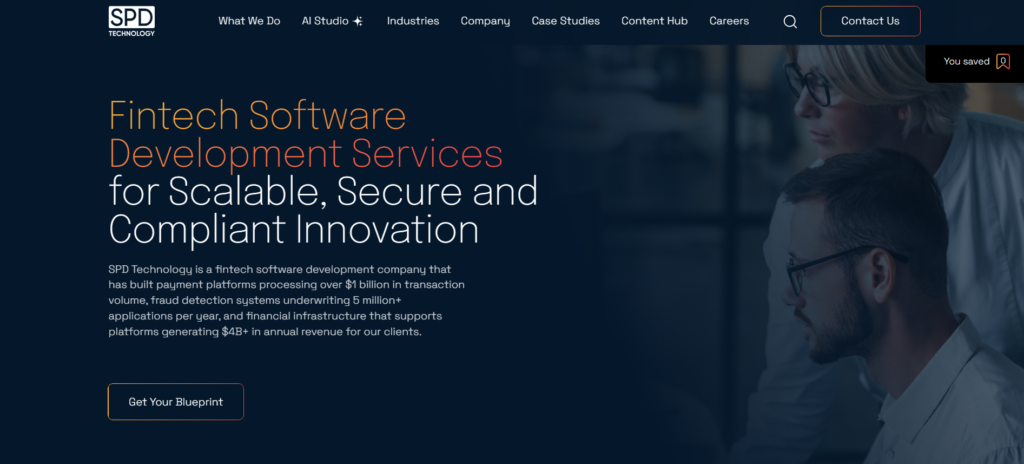
SPD Technology is a fintech development company for startups with 18+ years of experience building payment platforms, digital banking systems, and PSD2/PCI DSS-compliant fintech products.
Founded in 2006, the company works with startups, scale-ups, and product-driven businesses in the UK, US, and EU, helping them develop custom payment infrastructure, billing platforms, and regulated fintech products.
SPD Technology is particularly well-suited for early-stage fintech companies that need an engineering partner with experience in payments, lending, and digital banking.
Key Features
Custom payment platform development, billing software engineering, digital banking solutions, and end-to-end fintech product development with a strong focus on regulatory compliance and scalability.
Pros:
- 18+ years of fintech software development experience
- Expertise in PSD2 and PCI DSS-compliant systems
- Experience across payments, lending, and digital banking
Cons:
- Pricing is not publicly disclosed
- Best suited for companies requiring specialized fintech expertise
The Codest
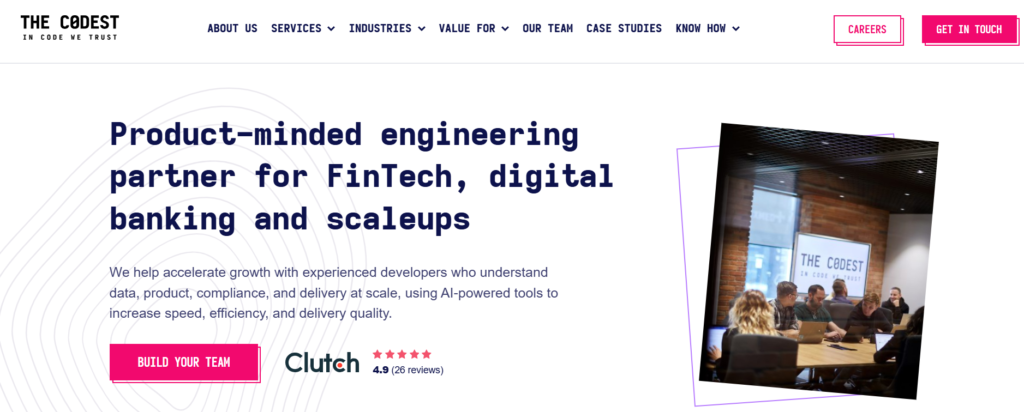
The Codest launched in 2020 and builds fintech solutions like a product team, not an outsourcing shop. They emphasize data, product, compliance, and scale early on, so regulatory planning is built in from the start.
Their hands-on leadership includes CTO support and engineers who’ve already delivered regulated systems. AI tools help them move more quickly while staying compliant. For startups caught between speed and regulatory needs, they split the difference effectively.
Key Features
Specialized fintech and digital banking focus with a product-first mindset. They pair custom engineering with strategic CTO guidance, making them ideal for founders who need both speed and regulatory credibility from the start.
Pros:
- Hands-on CTO partnership model accelerates founder decision-making
- Compliance baked into product roadmap from inception
- AI-assisted delivery keeps timelines tight without sacrificing rigor
Cons:
- Team size and certifications not published
- Pricing model requires direct consultation
Geniusee
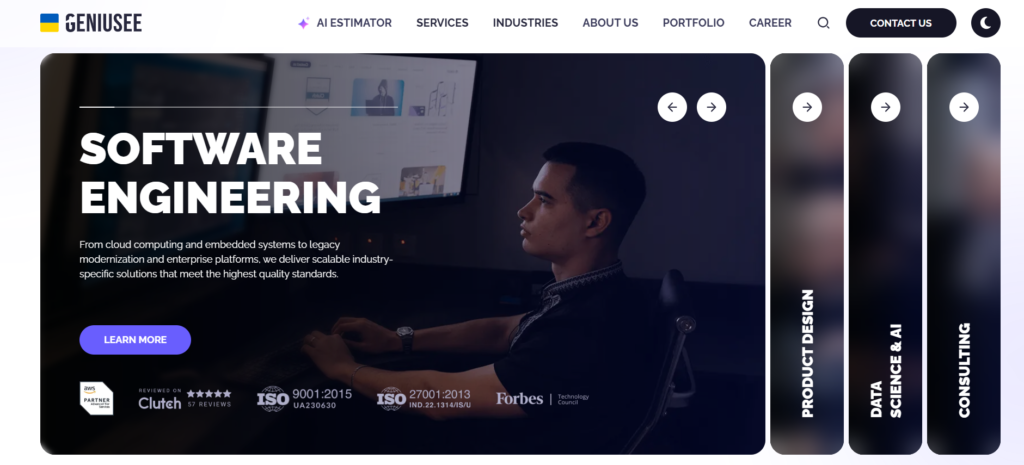
Geniusee was founded in 2017 and has quickly become a strong fintech development company for startups. They focus only on fintech and regulated software, with 180+ delivered projects and 250+ experienced engineers. They also hold AWS Advanced Partner status.
Their teams have actually shipped payment systems, lending platforms, and compliance-heavy products — no junior-heavy teams learning on the job. ISO 9001 and 27001 certifications mean quality and security are built into every step.
They handle custom software, AI solutions, and full-cycle development from architecture to production support. This mix works well for both startups and enterprises, so the systems stay lean at the start but hold up under regulatory pressure as you grow.
Key Features
Custom software engineering, AI-powered solutions, and full-cycle development from discovery through production operations. Their fintech-specific experience means they speak compliance language natively and can architect systems that pass regulatory review without rework cycles.
Pros:
- 180+ fintech projects = deep domain pattern recognition
- AWS Advanced Partner status + ISO certifications = infrastructure and process rigor
- Full-cycle ownership reduces handoff risk
Cons:
- Pricing model not published — expect custom quotes
ScienceSoft
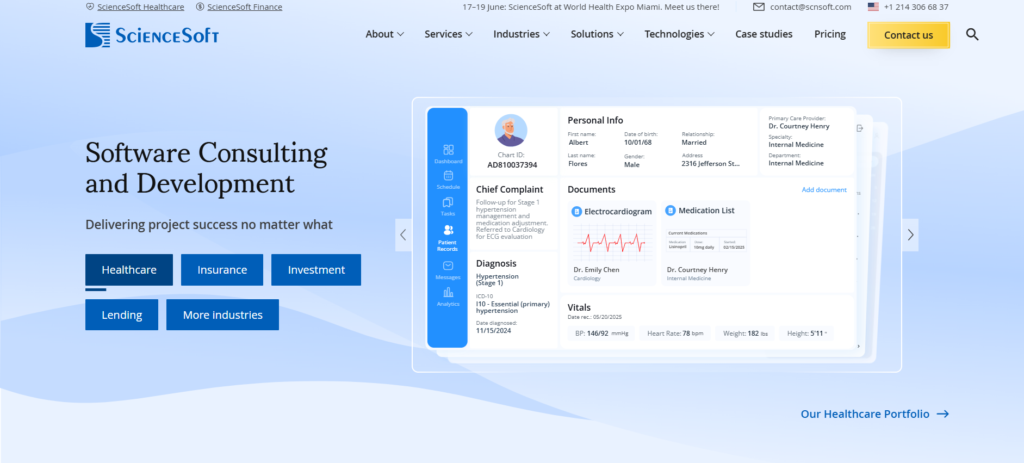
Founded back in 1989, ScienceSoft has 37 years of engineering know-how for fintech modernization. With 750+ consultants and over 4,200 projects delivered, they work at a real scale.
This setup suits established fintech companies or well-funded startups looking for serious industry expertise and the latest tech advancements. They focus on business transformation through software development, AI, and IT consulting — especially where regulatory issues and old systems need careful handling.
They’re great at solving complex challenges, but founders expecting quick agile sprints may notice the difference in rhythm.
Key Features
Focus on business outcomes and digital transformation across regulated industries. Combines legacy modernization expertise with AI and cloud-native development, positioning them as transformation architects rather than feature factories. Suitable for complex multi-system integrations and long-term engineering partnerships.
Pros:
- 37 years of software engineering experience
- Strong fintech, AI, and digital transformation expertise
- Well-suited for complex enterprise modernization projects
Cons:
- Less startup-focused than specialized fintech partners
- May be better suited to larger budgets and longer engagements
Computools
Computools started in 2013 and brings 250+ engineers to early-stage fintech builds. As a fintech development company for startups, it offers experience across payments, lending, and data-intensive financial applications. The company is a step above typical outsourcing providers, particularly for projects involving sensitive data, regulatory requirements, or complex financial workflows.
With ISO certifications, GDPR/HIPAA compliance, 400+ delivered projects, and Microsoft/AWS partner status, they check the important boxes for regulation and infrastructure.
Key Features
Compliance-focused development supported by ISO 27001 and HIPAA standards. Flexible engagement options include dedicated teams and staff augmentation. AWS and Microsoft partnerships provide cloud infrastructure flexibility for regulated applications.
Pros:
- Strong compliance and quality certifications reduce regulatory friction
- Proven track record across 400+ projects signals execution discipline
- Flexible team models fit early-stage budget constraints
Cons:
- Generalist software shop rather than fintech-specialized—you’ll need to educate them on domain nuance
- Pricing opaque; requires a custom quote based on scope
Euvic

Euvic delivers full-cycle IT services from idea to scale, combining tech and infrastructure. They highlight humility, transparency, and easy collaboration.
Services include consulting, software development, outsourcing, and staff augmentation. However, they’re a generalist IT partner, not focused on fintech. This can be a drawback for early founders working on compliance, payments, or regulated launches. They also don’t disclose the founding year or team size.
Euvic suits growth-stage teams needing flexible capacity, but startups building core fintech products from the ground up should consider more specialized options.
Key Features
Full-cycle delivery: strategy, development, deployment, and operations. Close collaboration and transparent communication. Flexible engagement models: dedicated teams, staff augmentation, or consulting.
Pros:
- Broad service range reduces vendor fragmentation
- Culture-first approach suits early-stage team dynamics
- Scales with your growth from MVP to enterprise
Cons:
- Lack of transparency on the founding year and team certifications limits confidence
Frequently Asked Questions
Q: What does a production-grade fintech MVP usually cost in 2026?
A: Specialized firms charge $80k–$250k depending on compliance needs and features. Senior engineers cost $80–$200/hour. Add a buffer if you want payment rails or lending logic included.
Q: How long to get a compliant payment system live?
A: Realistically, 4–8 months with all the reviews. Basic MVPs can go quicker, but audits always slow things down. Going too fast often creates more work later.
Q: Do partners include compliance help, or is it extra?
A: Basic advice is usually part of the package during planning. Serious regulatory strategy or licensing needs separate lawyers. Ask specifically about PCI DSS support.
Q: What’s the difference between fintech specialists and regular agencies?
A: Specialists know the regulated side — payments, AML, audits — from experience. Generalists don’t. You pay more upfront, but save on costly mistakes.
Q: Can I begin with staff augmentation?
A: Yes. Many partners let you add engineers or advisory support on flexible terms. Great option when you have product direction but need more hands quickly.
Conclusion
We ranked the best fintech software development companies on proven domain expertise, compliance credentials, scaling capability, team seniority, and pricing transparency.
For early-stage fintech founders, selecting the right development partner comes down to proven regulatory experience, not generalist claims. The best partners treat compliance as a core feature, bring senior engineers who have shipped regulated systems before, and offer flexible engagement models that scale from MVP to production without costly rewrites.
Prioritize firms with verifiable fintech portfolios, relevant certifications, and transparent team structures. Avoid shops that treat compliance as an afterthought or rely on junior-heavy teams learning on your dime.
The best fintech software development companies accelerate your launch and strengthen investor confidence; the wrong one burns runway and introduces preventable risk.