
Best 7 Digital Adoption Tools for IT and Operations Leaders
IT and operations leaders constantly wrestle with one core issue: driving adoption across many enterprise applications without exhausting end users or their teams. Standard training rarely solves it.
While most digital adoption tools focus on product teams building single apps, IT needs platforms that cover the entire stack — from ERP and CRM to HR and custom systems. They also want adoption data that connects directly to business outcomes. That mismatch between software spend and actual usage costs companies millions in unused licenses and lower productivity.
We evaluated the leading 7 platforms using five criteria: in-app guidance, cross-app tracking, integration and scale, AI personalization, and IT change management support.
The platforms vary in how they mix automation, governance, and ease of use. A few stand out for recording workflows with minimal developer help. Others focus on overlaying unified guidance across all applications.
Top 7 Digital Adoption Tools
The platforms below represent distinct approaches to the same problem: helping IT teams drive software adoption at scale. Some prioritize speed of documentation, others focus on cross-application intelligence, and a few specialize in specific use cases like revenue enablement or customer support.
Each has earned its place through documented enterprise deployments and measurable outcomes.
Tango
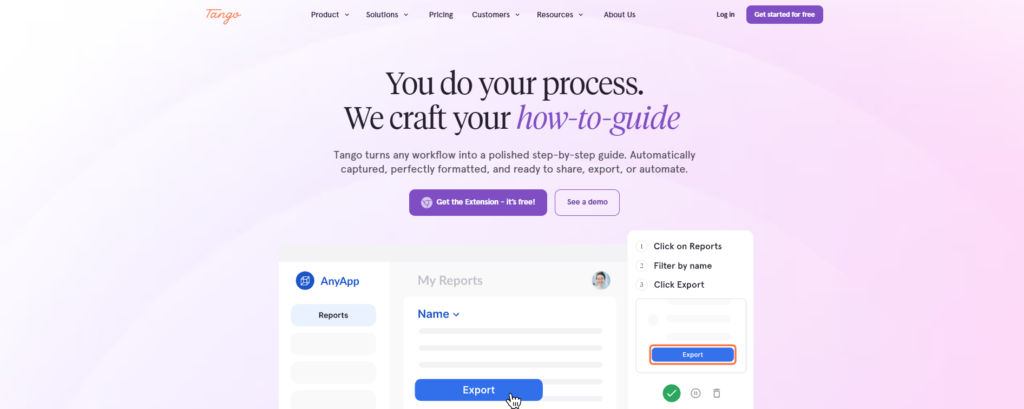
Tango is a digital adoption platform designed for software rollouts involving Salesforce, Oracle, NetSuite, and other enterprise systems. It helps organizations improve software adoption and process consistency without requiring integrations, API setup, or lengthy implementation projects.
Users simply complete a process once, and Tango automatically converts it into a polished step-by-step guide with screenshots that can be shared, embedded, exported, or used for training and knowledge sharing. The platform also includes sensitive-data protection features to help prevent credentials or personal information from appearing in documentation.
IT and operations leaders choose Tango when they need fast, scalable process documentation rather than another adoption platform that requires significant engineering effort. The browser-based solution works across CRM, ERP, HRIS, procurement, and other business applications, automatically generating guides that can be embedded into wikis, LMS platforms, knowledge bases, and helpdesk resources.
A free tier is available, with paid plans starting at $15 per user per month. For organizations rolling out Salesforce, Oracle, NetSuite, or multiple business systems at once, Tango is one of the strongest options for accelerating user adoption and standardizing workflows.
| Attribute | Value |
| Founded | 2020 |
| Best For | Fast workflow documentation and software adoption |
| Pricing | Free tier available |
| Notable Feature | Automatic step-by-step guide creation with screenshot capture and sensitive-data protection |
Why Choose This Platform?
Tango helps organizations accelerate software adoption by making process documentation fast and easy to create. Teams can’t effectively guide employees through Salesforce, Oracle, NetSuite, or other enterprise systems without clear documentation, yet creating and maintaining SOPs manually is time-consuming.
Tango automatically converts completed workflows into step-by-step guides with screenshots, allowing teams to document processes as they work and share guidance wherever employees need it.
It’s particularly well-suited for IT and operations leaders who need a practical way to support software rollouts without lengthy implementations or dedicated documentation resources.
WalkMe
Founded in 2011, WalkMe pioneered digital adoption and remains the platform with the longest track record in the space. WalkMe overlays every application with real-time context, cross-application reach, and workflow execution capabilities that standalone AI cannot achieve.
IT and operations leaders use it to track software adoption, automate workflows, and deliver in-app guidance across their entire application stack—not just single products. WalkMe is the critical layer that makes enterprise AI work by giving AI the context it needs to deliver results.
The platform’s UI Intelligence and digital adoption analytics let IT teams see exactly how employees use software and identify friction across workflows. You can build personalized experiences that drive adoption and measure ROI—WalkMe delivers 494% ROI according to their published data. The overlay approach means no API integrations or product-specific setup.
| Attribute | Value |
| Founded | 2011 |
| Best For | IT leaders managing adoption across multiple enterprise applications |
| Core Strength | Application overlay with real-time context and cross-app workflows |
| Notable Recognition | Gartner Leader, Nasdaq-listed 2021 |
Why Choose This Platform?
WalkMe is the right choice when you need adoption tracking and guidance that works across your entire software portfolio without vendor-specific integrations.
The overlay architecture means you can deploy once and cover SAP, Salesforce, Workday, and custom applications with the same platform. Discovery and visibility features show you where employees struggle before they file support tickets, and workflow automation eliminates repetitive tasks that slow down operations teams.
Winner of multiple 2025 AI Excellence awards, including Gold Globee for Best AI Integration into Existing Systems, WalkMe proves ROI at scale.
Whatfix
Whatfix was one of the first to push Userization — the idea that technology should bend to fit the user, not the reverse. Founded back in 2013, the platform pulls together in-app guidance, practice simulations, and usage intelligence. It gives IT leaders a practical way to measure adoption and ROI across their tools without pushing everyone through lengthy training sessions.
You can deploy it by simply layering guidance over your current apps, which keeps things straightforward. It shines when teams are handling several complex systems at once, from Salesforce to SAP and Workday.
Customers, including Microsoft, UPS, Cisco, and Flipkart, turn to it for fewer support tickets and smoother rollouts. The analytics dashboard reveals what’s actually being used, while a $125 million funding round in 2024 points to continued growth and investment.
| Attribute | Detail |
| Founded | 2013 |
| Best For | IT leaders managing adoption across multiple enterprise applications |
| Core Innovation | Userization philosophy — technology adapts to users |
| Notable Recognition | Forrester Wave Leader Q4 2024 |
Why Choose This Platform?
Whatfix solves the cross-application adoption problem that single-product DAPs can’t touch. Most platforms guide users through one SaaS tool; Whatfix tracks behavior and delivers contextual help across your entire software stack. The simulation engine is rare—users practice complex workflows without risking live data or creating support tickets.
Gartner Customers’ Choice recognition three years running (2024, 2025, 2026) reflects enterprise trust in high-stakes deployments. Worth it for organizations rolling out ERP, CRM, or HRIS platforms where adoption failure costs millions in sunk investment.
Pendo
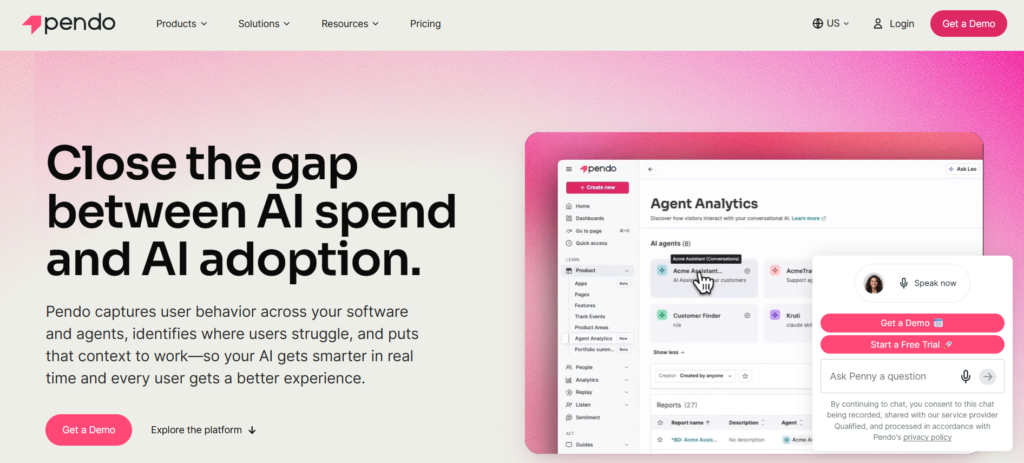
Pendo closes the disconnect between AI investment and real-world adoption. It ties behavioral data to products and agents while measuring true business impact.
Since 2013, it has combined analytics, in-app guides, session replay, and feedback tools into one easy platform. No data science team required. IT and ops leaders rely on it to track adoption across enterprise tools and connect usage to revenue.
The platform excels at turning raw data into practical insights. Teams identify what works and what doesn’t, then deploy targeted guides right away. Automated journey tools and sentiment analysis handle the rest, with smooth integrations into Jira, Salesforce, and Slack. Definitely worth considering if you need concrete numbers to support software spending decisions.
| Attribute | Value |
| Founded | 2013 |
| Best For | Connecting usage data to business outcomes |
| Notable Feature | Session replay with sentiment analysis |
| Compliance | SOC 2 Type II, GDPR, HIPAA, PCI DSS |
Why Choose This Platform?
Pendo excels when IT leaders need to prove that software investments deliver measurable results. The platform tracks adoption across every application in your stack, then surfaces which features correlate with retention, revenue, or support ticket reduction.
In-app guides and NPS surveys let you intervene before users churn, while native integrations with CRM, support, and marketing automation platforms ensure adoption insights reach the teams that can act on them. Most adoption tools stop at usage tracking—Pendo connects that data to the outcomes executives care about.
Appcues
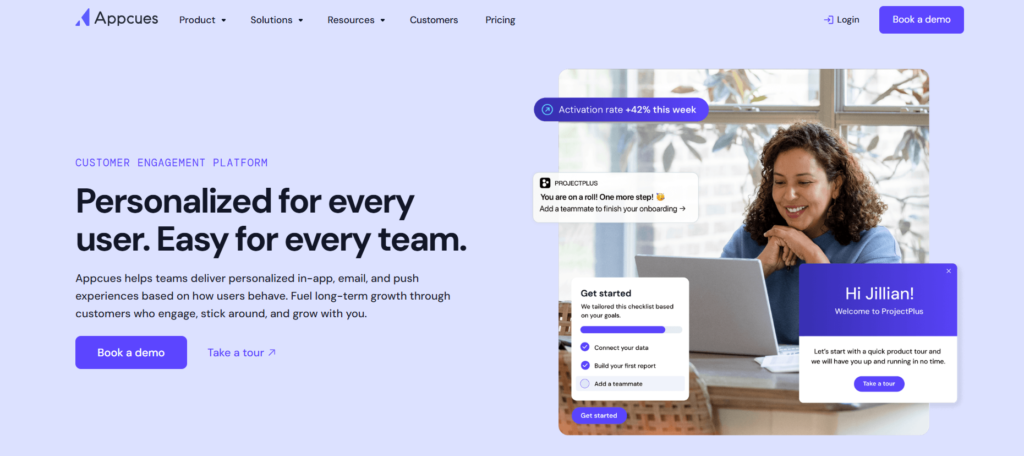
Founded in 2013, Appcues focuses on user engagement with personalized in-app experiences, emails, and push notifications that don’t require constant developer help.
The AI engine figures out what users need next, delivers it across different channels, and improves over time. As a result, product and operations teams can step back from execution details and concentrate on strategy. It’s particularly useful for IT leaders overseeing multiple applications who need guidance that grows without creating engineering headaches.
What really sets it apart is the multi-channel orchestration. Canva, Segment, Yotpo, and Lyft use it to guide users from initial onboarding to later campaigns. It earns a solid 4.6 out of 5 on G2 for being straightforward for non-technical teams.
One thing to keep in mind: it works best for individual app engagement, but offers less depth in cross-enterprise workflow visibility.
| Attribute | Value |
| Founded | 2013 |
| Best For | SaaS product teams driving multi-channel engagement |
| Pricing Start | Up to 3,000 MAUs with 10 published experiences |
| Notable Feature | AI engine personalizes across in-app, email, and push |
Why Choose This Platform?
Appcues removes developer dependencies from the adoption equation. Non-technical teams can build, test, and deploy personalized experiences in hours instead of sprint cycles. The AI engine continuously learns from user behavior to optimize messaging timing, content, and channel selection, which means your adoption campaigns get smarter over time without manual tuning.
For IT leaders supporting product-led organizations where speed matters more than deep enterprise integration, Appcues delivers fast time-to-value with minimal technical overhead.
Spekit
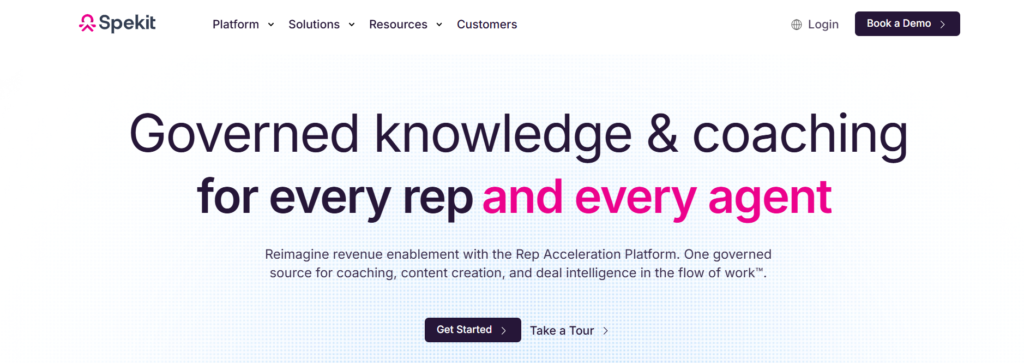
Spekit is a Rep Acceleration Platform that delivers AI-powered coaching, content, and deal intelligence inside the tools reps use to sell.
Launched in 2018, it focuses on helping sellers execute in their daily workflow rather than pushing them into separate training portals. It really delivers.
The Knowledge Engine manages company-wide content while Agentic Coaching gives reps personalized tips based on deal context and their own behavior. It creates content with AI, surfaces relevant insights, and supports action right in Salesforce, Outreach, or wherever reps are working.
IT and operations leaders appreciate how it drives adoption without forcing context switching or reliance on a separate LMS. Unified Deal Context and Deal Rooms connect buyer intelligence to timely coaching. As a women-led company, Spekit has raised more than $60M from top VCs, showing solid confidence in its hands-on approach to revenue enablement.
| Attribute | Value |
| Founded | 2018 |
| Best For | Revenue teams needing in-workflow coaching |
| Core Strength | Governed knowledge with agentic coaching |
| Notable Feature | AI Content Builder for knowledge creation |
Why Choose This Platform?
Spekit fits IT and operations leaders who are rolling out CRM or sales enablement platforms and need adoption to happen without pulling reps out of their daily workflow. The platform’s strength is delivering the right coaching and content at the moment of need—not in a separate training portal that requires behavior change.
If your adoption challenge centers on revenue teams and you want guidance that adapts to deal context and rep performance, Spekit’s flow-of-work architecture delivers measurable lift without requiring reps to adopt yet another tool.
Stonly
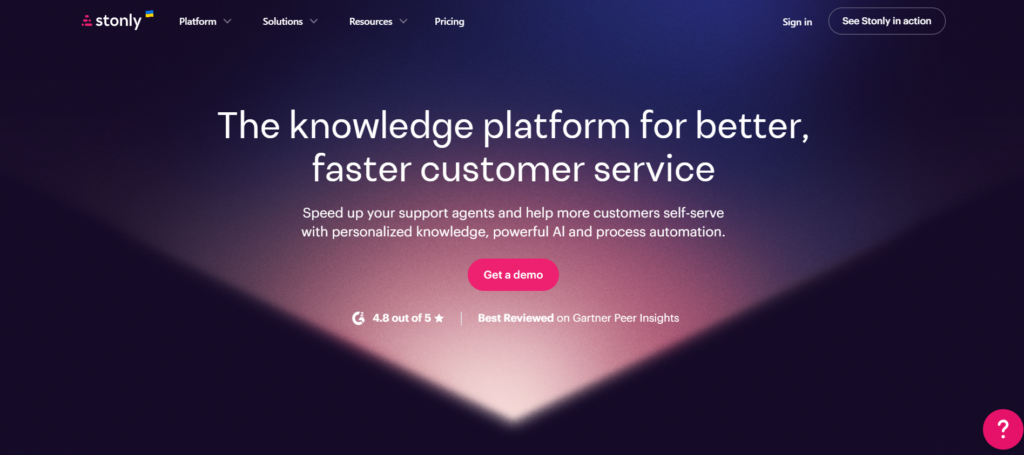
Stonly serves as a dedicated knowledge platform for quicker, more effective customer service. It converts static docs into interactive guides and step-by-step workflows.
Unlike product-focused adoption tools, Stonly is built for customer support. It reduces ticket volume by letting customers solve common issues themselves, which lowers support costs.
It blends AI chatbots for users with AI agent assistance. Customers get guided help first, while agents receive context for tougher cases. Analytics highlight what actually resolves problems.
For IT leaders, Stonly shines in post-launch support. It doesn’t match the cross-system automation of WalkMe or Whatfix, but its custom branding and contact forms maintain a professional, on-brand experience.
| Attribute | Value |
| Core Strength | Customer service knowledge delivery |
| Best For | Support teams reducing ticket volume |
| Notable Features | AI chatbot + agent assist in one platform |
| Adoption Focus | Post-implementation support and deflection |
Why Choose This Platform?
Select Stonly when support ticket volume after rollout is your main adoption challenge. It allows customer service teams to scale without adding headcount—interactive guides prevent tickets, and AI assists with complex issues.
Best suited for IT teams that track support cost per user and first-contact resolution rather than feature adoption across enterprise apps.
Conclusion
While most digital adoption platforms target product teams, IT and operations leaders face a broader issue. They need to drive adoption across a wide range of enterprise applications, not just one.
The seven platforms we looked at all deliver in-app guidance and useful analytics. But the right pick really depends on your specific needs — automated workflow tools, cross-application overlays, or strong AI personalization.
A strong platform ties these features together to create real ROI across your whole stack. Take a moment to note your three most pressing adoption gaps. From there, booking a few targeted demos makes a lot of sense.