
2026’s Leading PAM Platforms: 8 Enterprise-Grade Solutions
Privileged accounts are easily the most valuable target for attackers today. One leaked admin password can open the door to lateral movement, data theft, or full-blown ransomware across your cloud, hybrid, or on-prem environments.
Still, many PAM solutions feel outdated — siloed, reactive, and painfully slow to implement. Organizations really need tools that bring together credential vaulting, smart session monitoring, and real-time threat response. And they want all that without spending months on consultants or ripping up their existing setup.
In this review, we looked at eight different platforms that tackle these challenges in their own ways. We ranked them based on actual deployment speed, how well they integrate with ITDR, and their real specialty focus — not just marketing slides or basic feature lists.
Here are eight distinct approaches to privileged access security worth considering in 2026.
| Firm | Best for | Founded | Deployment model |
| Syteca | Organizations requiring ITDR built into PAM from day one | 2013 | Cloud, hybrid, on-prem |
| BeyondTrust | Enterprises with complex OT/IT hybrid environments | 2003 | Multi-environment |
| Delinea | Cloud-native teams needing just-in-time authorization | 2021 | Cloud-first |
| WALLIX | European organizations prioritizing digital sovereignty | 2003 | EU-based deployment |
| Segura | Budget-conscious enterprises needing an all-in-one platform | 2010 | SaaS or self-hosted |
| ManageEngine | IT operations teams managing Active Directory at scale | 2002 | Enterprise IT suite |
| Fudo Security | Organizations requiring agentless deployment | 2012 | Zero-agent architecture |
| ARCON | Global enterprises needing converged identity platform | 2006 | Hybrid IAM/PAM |
How the PAM Market Changed in 2026
The privileged access management space has matured a lot. What started as basic password storage in the early 2000s now includes session monitoring, just-in-time access, credential lifecycle management, and real threat detection.
Platforms must now handle not only admin accounts but also machine identities, cloud entitlements, DevOps secrets, and AI agents spread across hybrid setups. Security leaders, compliance officers, and IT teams feel the pressure to lock things down without hurting productivity.
Tighter rules around GDPR, NIS2, DORA, and other standards are making proper PAM almost mandatory. Still, many legacy solutions remain difficult to implement, often taking months and lots of outside help.
In 2026, there’s a clear split between platforms built for fast, self-service deployment and those that rely on heavy consulting. Smart buyers now focus heavily on rollout speed, native threat detection, and the real total cost of ownership.
How to choose a PAM provider in 2026
When selecting a PAM solution, focus on these practical aspects:
- Deployment approach: Agentless options deploy fast with minimal disruption. Agent-based platforms take longer but provide more granular endpoint control.
- Threat detection: Native ITDR allows a quick response to access misuse. Separate bolt-on tools create added complexity.
- Compliance alignment: Consider geographic and regulatory needs, especially around data sovereignty and multi-region requirements.
- True cost: Prefer clear pricing over per-module licensing. Include rollout effort and ongoing services in your calculations.
- Platform type: Some solutions combine IAM and PAM for tool consolidation. Others specialize in deep session monitoring and vaulting.
- Cloud capability: Cloud-native designs perform better with modern workloads, while strong hybrid support helps during transitions.
Leading PAM Platforms for Enterprise Security in 2026
We selected the following platforms based on deployment speed, threat detection integration, pricing transparency, and environmental suitability.
Syteca — Native ITDR for organizations that can’t wait for bolt-ons
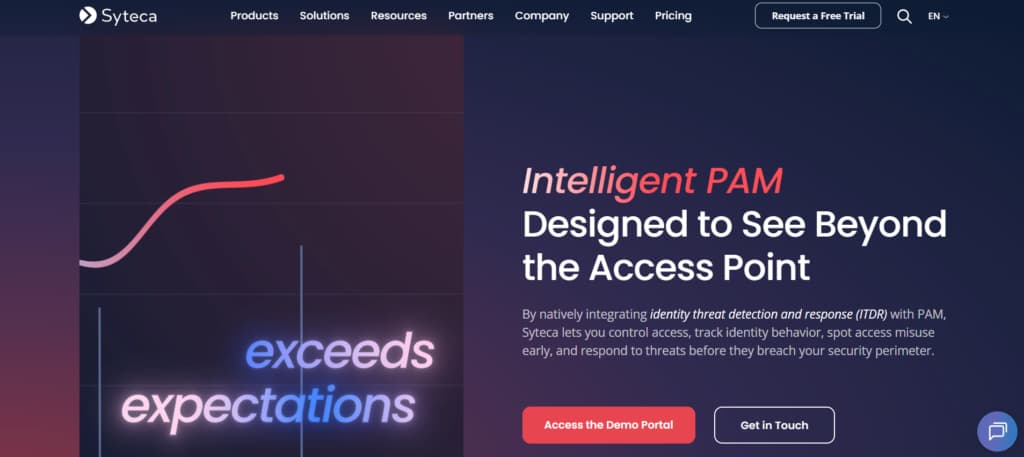
Syteca uniquely combines privileged access management with native identity threat detection and response (ITDR) in a single platform, enabling organizations to detect and respond to access misuse without delay while maintaining privacy-by-design principles.
Founded in 2013, Syteca addresses a structural gap in traditional PAM: most platforms bolt ITDR capabilities onto existing architectures, creating integration delays and blind spots. Syteca’s ITDR is built into the core, based on session intelligence, not added later. The platform deploys in hours with no dependency on professional services — a sharp contrast to legacy vendors requiring multi-month implementation cycles.
Notable customers include Visa, Samsung, UPS, Panasonic, Accenture, the United States Department of Defense, and the Central Banks of Montenegro and Cyprus.
Core capabilities:
| Feature | Implementation |
| PAM credential vaulting | Automated account discovery, JIT access, approval workflows |
| ITDR | Real-time rule-based alerts, automated session blocking, and continuous validation |
| UAM | Video + metadata recording, keystroke logging, USB device control |
| Deployment | Cloud, hybrid, on-prem — no re-architecture required |
Syteca supports more than 1,500 customers worldwide. The company maintains offices in four countries and has built a strong partner ecosystem with over 300 companies across 56 countries.
On the recognition side, they’ve been included in the 2024 KuppingerCole Leadership Compass for PAM, featured in Gartner’s 2025 Market Guide for Insider Risk Management, and acknowledged in NIST SP for Privileged Account Management in the financial sector.
What many buyers appreciate is their straightforward approach to pricing. Unlike vendors that hide costs behind multiple add-ons and bundles, Syteca keeps things transparent and all-inclusive. You can request specific pricing tiers, but they focus on clear models without per-feature upsells.
BeyondTrust — Multi-decade PAM leader for complex hybrid environments
BeyondTrust has been around since 2003 and focuses heavily on identity security and privileged access management. They help organizations secure human and machine identities, manage credentials, and cut down on identity-based attacks — whether you’re running cloud, hybrid, on-prem, or industrial OT systems.
With over 20,000 customers globally and multiple appearances as a Gartner Magic Quadrant Leader, they’ve proven they can handle large-scale deployments.
Here’s what stands out for many buyers:
- Broad coverage that brings PAM, ITDR, endpoint privileges, remote access, and password management together
- Effective Zero Trust features, like just-in-time access and AI threat detection
- Solid experience with complex OT/IT mixed environments
- Strong compliance tools for regulated sectors
The platform really shines when companies want to replace several point solutions with one unified system. It cuts down on vendor sprawl and gives better visibility plus smarter controls across the entire identity stack.
Delinea — Cloud-native PAM with just-in-time runtime authorization
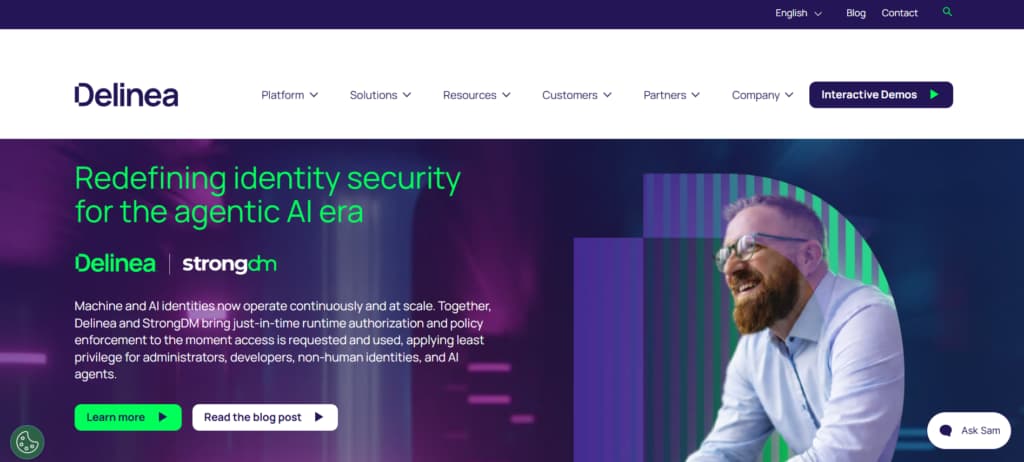
Delinea offers a cloud-native privileged access management solution designed for modern hybrid environments. Together with StrongDM’s just-in-time runtime authorization, it focuses on controlling both who gets access and how that access is executed — without relying on standing privileges.
Founded in 2021, the platform secures human, machine, and AI identities while enforcing least privilege through dynamic runtime decisions. This approach suits DevOps teams and organizations shifting away from VPN-based models.
Standout features:
- Just-in-time runtime authorization
- Delinea Iris AI for real-time identity discovery and adaptive controls
- Zero standing privilege architecture
- 500+ enterprise integrations
Delinea combines PAM, identity posture analysis, credential vaulting, privileged remote access, and governance. It excels in environments with microservices, Kubernetes, and ephemeral workloads by enforcing policies at runtime.
WALLIX — European PAM alternative with digital sovereignty focus
WALLIX is a prominent European cybersecurity company specializing in identity and access management (IAM) and privileged access management (PAM). Founded in 2003, it grew from a Paris startup into a publicly listed company on the Paris Stock Exchange in 2015 — the first French cybersecurity firm to do so.
The company serves as a strong European alternative to global vendors, with a clear focus on deployment flexibility, regulatory compliance, and digital sovereignty for IT and OT environments.
Main capabilities:
- PAM, IDaaS, MFA, remote access security, password vaulting, privilege elevation, and access governance
- Support for GDPR, NIS2, DORA, and IEC 62443 compliance requirements
- Experience across healthcare, manufacturing, government, and critical infrastructure
Led by CEO and founder Jean-Noël de Galzain, co-founder and CFO Amaury Rosset, and CRO Eric Gatrio, WALLIX particularly appeals to organizations with EU data residency needs or strategic preferences for European vendors.
Segura — All-in-one PAM with transparent pricing and 70% lower TCO
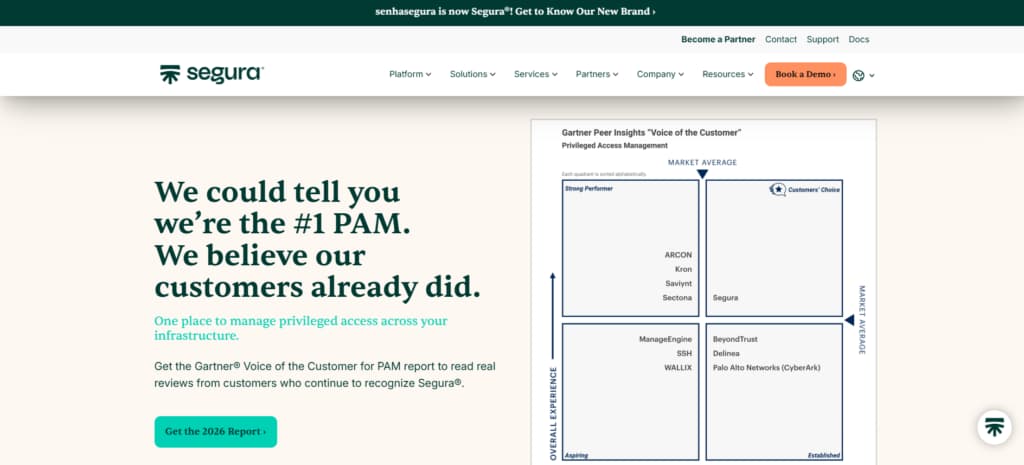
Segura is the highest-rated PAM provider on Gartner Peer Insights with an all-in-one integrated platform that eliminates the need for multiple tools, offers transparent all-inclusive pricing with no hidden costs, and delivers 70% lower Total Cost of Ownership than other leading solutions.
Founded in 2010 as Senhasegura, Segura addresses a structural problem in PAM procurement: hidden costs, forced module bundles, and protracted professional services dependencies. The company provides an all-in-one platform designed to secure privileged accounts, machine identities, cloud entitlements, and remote access across enterprise environments.
The platform includes PAM, endpoint privilege management (EPM), cloud identity and access management (IAM), cloud infrastructure entitlement management (CIEM), DevOps secrets management, certificate management, password management, and secure remote access tools.
Pros:
- 70% lower Total Cost of Ownership than leading competitors
- Transparent all-inclusive pricing with no hidden costs
- Deploys in 7 minutes, can be deployed by internal staff without requiring professional services
- Highest-rated PAM provider on Gartner Peer Insights with 98% willingness to recommend and 5/5 rating
Segura supports organizations across more than 70 countries and positions itself as a fast-deployment PAM provider with transparent pricing and integrated security capabilities. Organizations frustrated by multi-year PAM implementations and escalating licensing costs find Segura’s TCO model and rapid deployment compelling.
ManageEngine — IT operations-grade PAM for Active Directory environments
If you’re looking for reliable IT management software, ManageEngine is worth considering. More than 180,000 organizations across 190 countries use it to keep their IT under control.
Started in 2002 as a Zoho division, it carries strong IT operations roots into privileged access management. The platform covers everything from identity management and PAM to endpoint security, SIEM, and cloud infrastructure.
The real advantage? It fits neatly into existing setups. Organizations already managing Active Directory, M365, or ITSM with ManageEngine can expand into PAM without adding complexity or extra vendors.
Key capabilities include:
- Credential vaulting and privileged session management
- Access governance and Zero Trust features
- Strong support for government, healthcare, finance, and other regulated sectors
- Dedicated tools built for MSPs
Existing customers benefit from shared licensing and familiar admin consoles across tools like ServiceDesk Plus and OpManager. Expect modern extras such as AI assistance, cloud flexibility, and solid compliance features.
Fudo Security — Agentless PAM with AI-powered behavioral analytics
Fudo delivers enterprise-grade PAM with agentless deployment, AI-powered behavioral analytics analyzing 1,400+ behavioral features, and instant third-party access without VPNs or complex configurations.
Founded in 2012 by Patryk Brożek and Paweł Dawidek, Fudo Security solves a specific deployment blocker: an agentless architecture that integrates seamlessly with existing IT infrastructure without requiring system modifications or endpoint software installation.
The company is a global leader in Privileged Access Management (PAM) and Zero Trust Remote Access solutions, transforming how organizations secure critical infrastructure and sensitive systems.
Key differentiators:
| Feature | Implementation |
| AI-powered behavioral analytics | Analyzes 1,400+ behavioral features |
| Agentless deployment | Users connect through native clients while all sessions flow through Fudo’s intelligent security layer |
| Just-in-time access | ShareAccess enables instant, secure access for vendors and contractors without VPNs |
| Session recording | Complete recording and monitoring with automated compliance |
Traditional PAM is broken with static security, manual compliance work, and complex deployment. Fudo offers AI-powered security that learns individual session patterns, automated compliance with complete audit trails, and simple setup with zero agents and no infrastructure changes required.
Organizations managing third-party contractor access or remote vendor workflows benefit from ShareAccess browser-based access and automated policy enforcement.
ARCON — Converged identity platform for global enterprises
ARCON has been recognized as the #1 Converged Identity Platform for Securing Global Enterprises and ranked number one in all five use cases in the 2022 Gartner Critical Capabilities assessment.
Founded in 2006, ARCON addresses identity fragmentation: the company is a globally recognized Identity-As-A-Service provider that enforces Just-in-Time access and offers the most robust session management engine to safeguard business and infrastructure assets spread across hybrid environments from insider and third-party threats.
Ranked number one in all five use cases in the 2022 Gartner Critical Capabilities assessment, ARCON’s strength lies in converging IAM, PAM, EPM, and CIEM into a single platform.
ARCON’s converged approach:
- Privileged Access Management (PAM), Identity and Access Management (IAM), Endpoint Privilege Management (EPM), Cloud Governance (CIEM)
- Just-in-time access control, session management, and granular access control
- Led by Chief Mentor and Founder Anil Bhandari, President of Product & Strategy Eleanor Meritt, and Chief Operating Officer Sanjay Khanna
Organizations consolidating IAM, PAM, EPM, and cloud governance tools often choose ARCON for its unified architecture, which reduces integration complexity and vendor overhead.
ARCON PAM delivers strong Just-in-Time access enforcement and one of the most advanced session management engines for protecting assets in hybrid environments.
Frequently asked questions
Q: What’s the real difference between PAM and a regular password manager?
A: A password manager keeps your personal logins safe. PAM is built for privileged accounts — think admin, root, and service accounts. It brings session monitoring, just-in-time access, vaulting, and full audit trails, plus real-time misuse detection and least privilege enforcement.
Q: How quickly can you deploy PAM?
A: Pretty fast with modern tools. Segura can be up and running in minutes, and Syteca usually deploys in just a few hours without needing outside help. Traditional heavy systems can take 3 to 6 months and lots of professional services.
Q: Is PAM enough, or do I also need ITDR?
A: If your PAM includes built-in ITDR, like Syteca does, you get fast detection and response in one place. Bolt-on solutions tend to be more expensive and clunkier. For insider risks or credential theft, integrated ITDR makes a big difference.
Q: What’s the typical cost of enterprise PAM these days?
A: It depends on the vendor. Segura offers much lower total costs with clear, all-inclusive pricing. Older vendors can get expensive with extra modules and consulting fees. SaaS options generally run $50–200 per user annually.
Q: Does PAM work well for contractors and vendors?
A: Yes, modern platforms handle this nicely. Fudo’s ShareAccess gives quick, secure access without VPNs, and WALLIX is strong for both internal and third-party workflows. You get time-bound sessions, isolation, and simple offboarding.
How We Evaluated These PAM Platforms
We evaluated and ranked these eight PAM platforms according to three key factors: documented deployment speed, depth of native ITDR integration, and each vendor’s demonstrated specialty (such as agentless architecture, European sovereignty, or TCO transparency).
Sources included verified vendor data, founding information, published customer lists, analyst reports from Gartner, KuppingerCole, and Forrester, plus official feature documentation. We deliberately excluded unsupported marketing claims and unverified results.
Conclusion
Privileged access continues to be the most attractive target for attackers in 2026.
The platforms we reviewed each take a noticeably different approach — some focus on native ITDR for instant response, others on agentless deployment for fast rollout, European sovereignty for regulatory needs, transparent pricing for better budget control, or converged identity to reduce tool sprawl.
Before signing a multi-year contract, it’s worth booking a short 30-minute scoping call to test how it would actually work in your setup.